

 TH
TH MM
MM
A medical certificate for food handlers is essential if you are in the food business or work in a role involving food preparation and handling. It serves as proof that you have undergone the required health checks in accordance with the law, helping to minimize the risk of spreading infections or communicable diseases to consumers.
This article explains the key health examinations involved and the diseases that are screened for, so you can be fully prepared when applying for the certificate.
Key points about a food handler’s medical certificate:
- Required health check items for issuing the certificate
- Cost of a food handler’s medical certificate
- Types of communicable diseases transmitted by food handlers
- Who qualifies as a food handler
Health Checkup Items for Issuing a Food Handler’s Medical Certificate
A Food Handler’s Medical Certificate typically includes the following health examinations:
- Physical Examination
- Medical Certificate Issuance
- Vital signs such as pulse rate, blood pressure, body weight, and height measurement
- HBsAg Test for Hepatitis B virus
- HAV (IgM) Test for Hepatitis A virus
- Stool Culture (C/S)
- Lung Examination by Auscultation
Cost of a Food Handler’s Medical Certificate
- Food Handler’s Medical Certificate: 1,290 THB
- Note: Additional charges may apply if you request extra health check services. Please consult the staff for details in advance.

Communicable Diseases Transmitted by Food Handlers
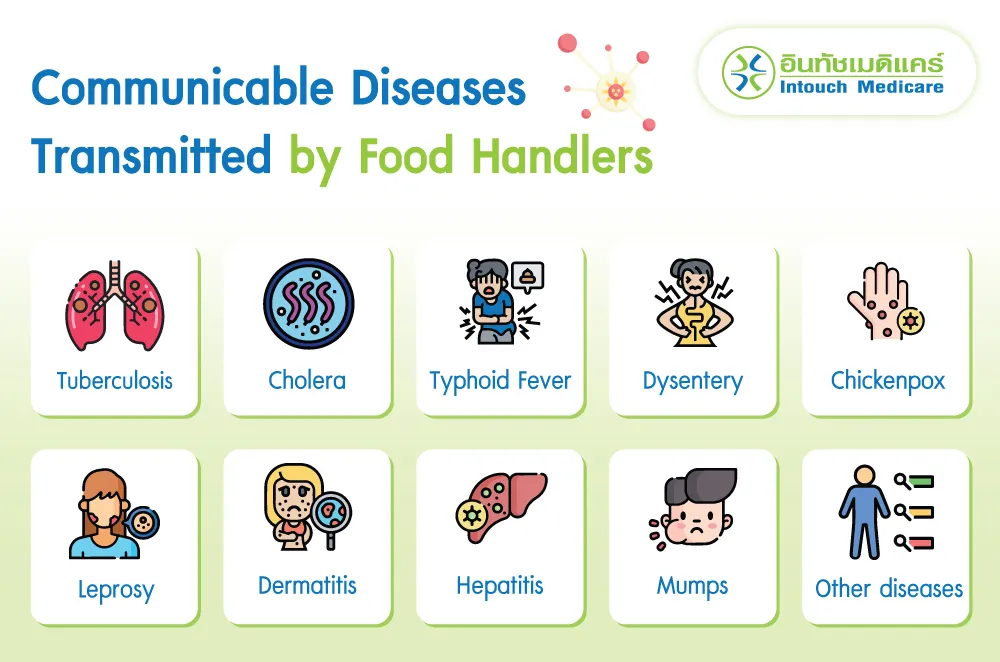
The following diseases can be transmitted through food handlers:
- Tuberculosis
- Cholera
- Typhoid Fever
- Dysentery
- Chickenpox
- Leprosy
- Dermatitis
- Hepatitis
- Mumps
Food handlers can transmit diseases in several ways, such as:
- Contact with food as a carrier of gastrointestinal infectious diseases – by touching food that contains the pathogens of the disease, such as typhoid fever, without showing any symptoms.
- Having a disease that spreads through direct contact – coming into contact with mucus or saliva and then touching food with unclean hands, such as typhoid fever, diarrhea, and dysentery.
- Having a disease that spreads through coughing, sneezing, or nasal discharge – during conversation or when droplets contact food, such as tuberculosis, hepatitis A, and the common cold.
- Having wounds, boils, pus, or pathogens in wounds – which can contaminate food during preparation or handling.
- Not maintaining hygiene while preparing or handling food – which may result in food contamination.
Who are food handlers?
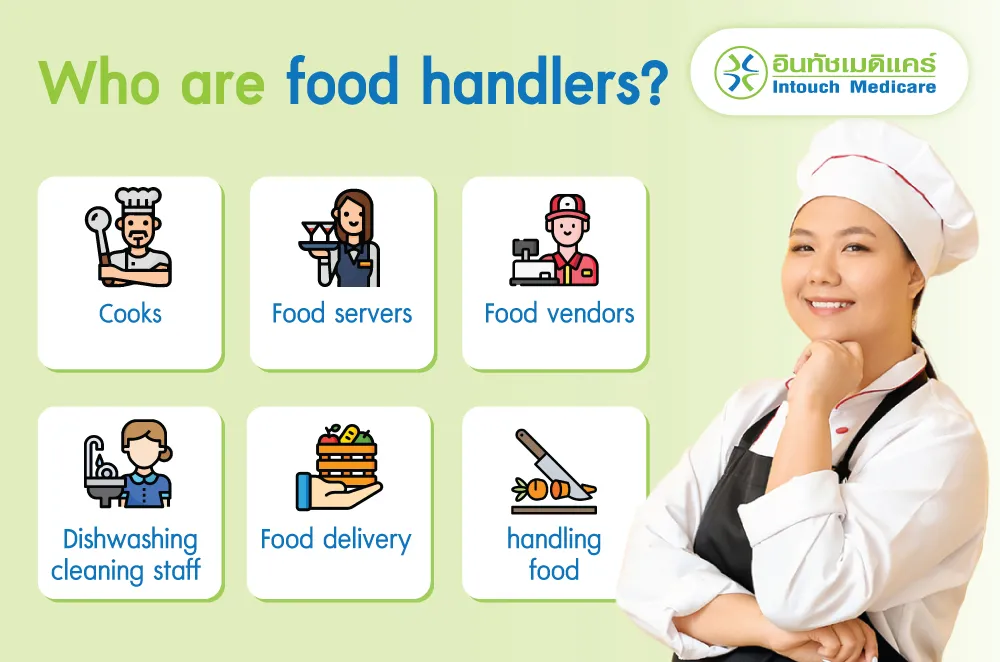
Food handlers are individuals who work or have occupations related to food preparation and handling, including:
- Food preparers
- Cooks, such as chefs or kitchen staff
- Food servers – waitstaff or restaurant employees
- Food vendors
- Dishwashing and cleaning staff – those who clean utensils and equipment used in food preparation
- Food delivery or transport staff
- Other occupations related to handling food
Do food handlers need training?
Individuals who wish to obtain a Food Handler Identification Card are required to complete the “Food Sanitation Course for Food Handlers” provided by the Department of Health or pass a knowledge test conducted by local government authorities. Candidates must achieve the passing score set by the Department of Health.
Validity of the training certificate
The certificate is valid for 3 years. Cardholders must renew their identification card every 3 years, and it is recommended to attend a refresher training before renewing the card.
Required documents for food handlers
To apply for a Food Handler Identification Card, the following documents are required:
- Certificate showing completion of training, or certificate showing passing of the knowledge test, with prior attendance of the food sanitation training required.
- Copy of identification card.
- One-inch frontal photograph (taken within the last 6 months).
- Food handler medical certificate, to certify that the applicant has undergone the food handler health examination.
For those working in the food industry who wish to undergo a health check, medical examinations for obtaining a Food Handler Medical Certificate are available at all Intouchmedicare branches.
We have a team of experienced doctors and nurses ready to provide guidance, along with modern and safe equipment that meets standards. Every health check is conducted thoroughly before issuing the medical certificate, ensuring you receive the most accurate results.
Reference
- Food Sanitation and Water Division, Department of Health, Ministry of Public Health, Food Handlers.
For more info and make appointment

Mr.Achawin Thamsoonthorn
General Manager
 Latest edit : 24/10/2025 (The website has been updated.)
 Images may be used without prior permission exclusively for educational or informational purposes, as long as proper credit is given to intouchmedicare.com